
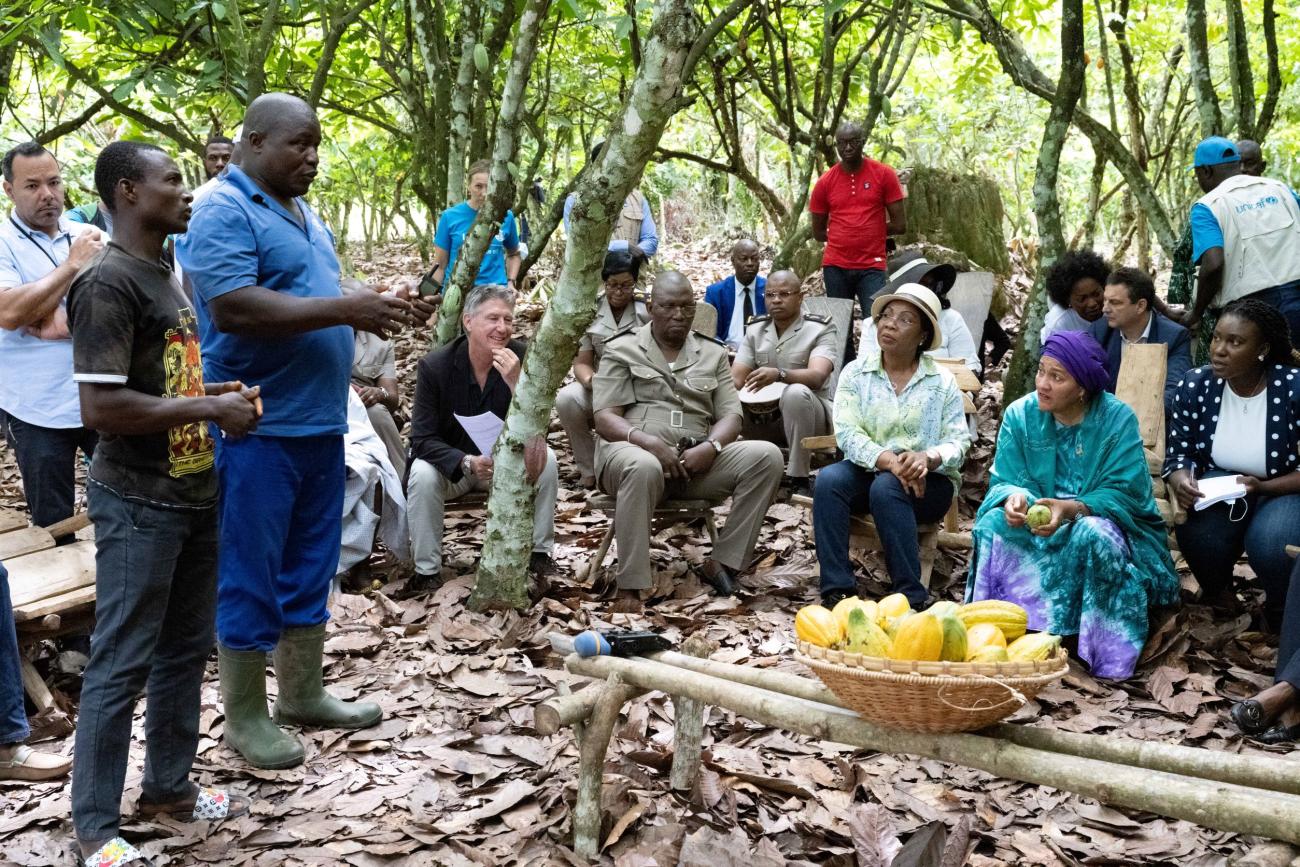
Ivory Coast accounts for roughly 40% of global cocoa supply, producing around 2 million metric tons in recent seasons. Cocoa is central to the country’s export earnings and to the livelihoods of millions of smallholder families. At the same time, the sector faces structural challenges: low farmer incomes, persistent child labor, aging trees and low productivity, deforestation, and fragmented supply chains. Corporate social responsibility (CSR) efforts combined with modern traceability systems are increasingly positioned as the levers that can align industry profit with social and environmental outcomes.
The CSR environment: regulations, corporate pledges, and key hurdles
CSR efforts in Ivory Coast are a mix of public policy initiatives and private sector programs. Key policy moves include the governments’ introduction of a Living Income Differential (LID) in 2019–2020, a fixed premium intended to raise the price floor for cocoa beans. Major chocolate and cocoa processors have publicly committed to targets on deforestation-free sourcing, improved farmer incomes, and child labor remediation through initiatives like the Cocoa & Forests Initiative and company-level programs (for example, Nestlé’s Cocoa Plan, Cargill Cocoa Promise, Olam’s AtSource, Barry Callebaut’s Forever Chocolate).
Main challenges that CSR must address:
- Low household incomes: A significant share of cocoa-growing households continue to make far less than recognized living income thresholds; price changes alone rarely boost net earnings unless service models, farmer coordination, and overall cost structures are adjusted.
- Weak bargaining power: Smallholder producers often rely on local middlemen and informal buyers, which restricts their ability to secure premiums and limits access to traceability information.
- Environmental pressures: Expansion linked to cocoa cultivation has played a role in deforestation; addressing this calls for robust supply chain verification and informed land-use management.
- Labor and social risks: Child labor and unstable working conditions remain present, demanding consistent oversight and community-focused corrective measures.
Traceability: its benefits and the way it operates
Traceability plays a crucial role in credible CSR, linking buyers’ pledges with real conditions on the ground. Effective traceability systems blend on-site data gathering with clear, reliable documentation and consistent verification.
Key traceability components:
- Farmer registration and geotagging: Digital IDs for farmers and geolocation of farms or buying points so beans can be traced back to the community level.
- Transaction recording: Digital capture of volumes, prices, and premiums at the point of purchase—often via mobile apps or SMS-enabled systems.
- Chain-of-custody tracking: Lot-level tracking through collection centers, cooperatives, and processors to prevent mixing of certified/traceable and non-traceable volumes.
- Independent verification: Third-party audits, satellite monitoring for deforestation, and community grievance mechanisms.
- Data transparency: Dashboards and reports that allow buyers, regulators, and civil society to monitor performance across social and environmental KPIs.
Technologies employed span simple mobile applications to sophisticated systems, including digital registries for farmers, cloud-based databases, satellite-enabled forest tracking integrated with platforms such as Global Forest Watch, and experimental blockchain deployments designed to reinforce immutable documentation. Illustrative private-sector traceability experiments feature end-to-end tracking assertions by certain brands following beans from cooperative to bar, as well as supplier platforms that merge procurement information with sustainability metrics.
What traceability achieves:
- Supports more precise investment decisions, such as directing resources toward revitalizing underperforming farms pinpointed within a specific district.
- Strengthens consumer confidence by providing evidence for sustainability assertions.
- Helps uphold requirements for deforestation-free sourcing and labor protections.
Limitations and risks:
- Traceability that ends at the cooperative or purchasing hub may fail to capture what truly happens on individual farms.
- Elevated expenses and unreliable information—such as fraud, flawed geolocation, or mistakes from manual data input—can weaken these systems.
- Traceability by itself does not improve earnings unless premium structures, support services, and market access are designed to deliver value to farmers.
Routes toward enhanced earnings for growers
Enhancing incomes calls for a multi-tiered approach that blends pricing tools with productivity gains, expanded financial access, and more robust market oversight.
Interventions that have shown promising effects:
- Price premiums and differentiated sourcing: Although LID payments and buyer-funded premiums can boost revenue, they must remain clearly traceable and verifiable to ensure that resources reach farmers rather than intermediaries.
- Farmer organization and commercial aggregation: Robust cooperatives or farmer-led enterprises strengthen negotiating capacity, facilitate bulk transactions, and cut overall transaction expenses.
- Productivity and rehabilitating old trees: Technical support for pruning, fertilizing, and renewing aging cocoa stands elevates per-hectare yields and reinforces long-term income stability.
- Access to finance: Input credit, crop insurance, and advance disbursements tied to documented production plans enable farmers to fund investments that improve yields.
- Diversification and agroforestry: Integrating food crops, shade species, or alternative cash crops reduces exposure to risk and offers near-term earnings as perennial trees develop.
- Children’s education and social services: Tackling child labor demands funding for schooling, viable local job options, and social protection systems that lessen families’ dependence on children’s work.
Case examples:
- Company programs tied to traceability: Certain buyers release sustainability premiums only when purchases can be fully traced back to registered farmers, which encourages enrollment and improves data reliability.
- Full-chain pilots: Brands that achieved complete cocoa traceability from farm to factory noted valuable insights into how premiums move through cooperatives and where losses arise, leading them to revise sourcing and payment systems so farmers obtained a larger portion.
- Landscape-level approaches: Public-private efforts integrating forest surveillance, community land-use planning, and payment-for-ecosystem-services trials have curbed unlawful deforestation while bolstering alternative income options for impacted communities.
Measuring impact: metrics and accountability
Robust monitoring calls for a diverse blend of economic, social, and environmental indicators:
- Income metrics: farm-gate prices, premiums earned by each farmer, overall household net income, and projected living-income gaps.
- Productivity metrics: per-hectare yield levels, distribution of tree ages, and the degree to which good agricultural practices are being adopted.
- Social metrics: reported cases of child labor, school attendance rates, and income information broken down by gender.
- Environmental metrics: areas of cocoa-linked deforestation, uptake of agroforestry systems, and adherence to zero-deforestation sourcing standards.
Accountability mechanisms should include independent audits, community grievance procedures, and public reporting by companies on volumes covered by traceability and the distribution of premiums.
Financial considerations and system scalability
Scaling effective models will require blended finance, multistakeholder coordination, and reallocation of industry margins:
- Public funds and multilateral finance can de-risk investments in farmer organizations and replanting programs.
- Companies can internalize the cost of sustainable sourcing through dedicated sustainability budgets and by pricing finished products to reflect true supply chain costs.
- Donors and impact investors play a role in financing systemic infrastructure such as digital registration platforms and landscape-level conservation investments.
Key risks to monitor and methods for reducing their impact
Potential pitfalls include superficial traceability (“traceability washing”), diversion of premiums before reaching farmers, and unintended social impacts of rapid policy changes. Mitigation involves:
- Independent verification and third-party audits.
- Transparent, farmer-level reporting of payments.
- Phased policy implementation that pairs price measures with capacity building for farmer organizations and local governance.
A robust CSR framework in Ivory Coast’s cocoa industry brings together reliable traceability, enforceable pricing and premium structures, investments that enhance productivity and encourage diversification, and social protections rooted in local communities. When these components are fully coordinated, supported by open reporting and independent oversight, the industry can advance toward deforestation‑free supply chains while securing substantially higher and more stable earnings for smallholder cocoa producers. This represents not a short-term procurement tweak but a structural transformation that depends on collaboration among governments, buyers, financial institutions, civil society, and farmers, along with a long-term commitment to track who truly gains at the farm level.