

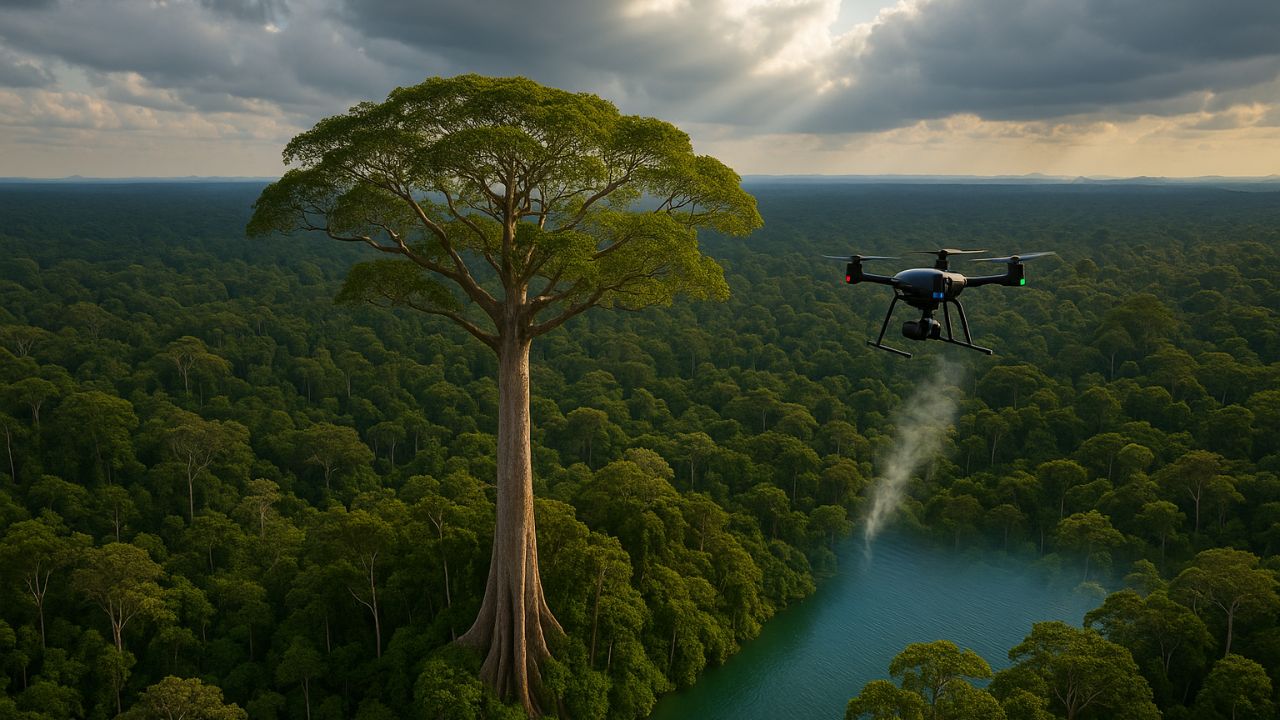
At the core of the Amazon, a fresh wave of technological innovation is rising as a powerful partner for the natural world. Artificial intelligence and unmanned aerial vehicles are revolutionizing Brazil’s approach to overseeing, safeguarding, and rejuvenating its expansive rainforest.
Technological advancements in woodland preservation
Once reliant on satellite imagery and human patrols, Brazil’s environmental organizations are now incorporating artificial intelligence (AI) and drone monitoring to protect the Amazon rainforest. This fusion of technological innovation and ecological expertise has forged a robust new paradigm for forest preservation—a system that functions with greater speed, enhanced accuracy, and at a scope previously inconceivable.
The Amazon rainforest, spanning more than five million square kilometers, is home to over three million species of plants and animals. It also plays a crucial role in regulating the planet’s climate by absorbing carbon dioxide and releasing oxygen. Yet this vital ecosystem faces persistent threats from illegal logging, deforestation, and wildfires. Detecting and responding to these dangers in time has always been one of the greatest challenges for conservationists.
That situation is currently evolving. Artificial intelligence-powered systems, operating alongside unmanned aerial vehicles, are empowering authorities and scientists to detect indicators of woodland devastation nearly instantaneously. Drones are capable of traversing distant and hard-to-reach regions, acquiring high-definition imagery and information that AI algorithms then scrutinize for anomalous patterns—like deforestation, smoke plumes from blazes, or unauthorized logging routes. This methodology facilitates the prompt dispatch of notifications to local park rangers or environmental agencies, enabling them to intervene before the harm escalates.
A new frontier in environmental monitoring
Organizations such as the Brazilian Institute of Environment and Renewable Natural Resources (IBAMA), along with various non-governmental organizations, are dedicating more resources to artificial intelligence-driven solutions. These systems integrate satellite information with drone footage captured on-site, enabling them to pinpoint deforestation trends with remarkable accuracy. This advanced technology is capable of distinguishing between natural, seasonal tree loss and destructive human-induced activities.
Machine learning, a subset of artificial intelligence, is instrumental in driving this change. Through the process of training algorithms with vast datasets of images from both thriving and compromised forest regions, researchers have developed models that can pinpoint initial signs of environmental disruption. These models possess the capability to forecast future locations of illicit deforestation, enabling officials to allocate resources in an anticipatory rather than a responsive manner.
Some unmanned aerial vehicles come equipped with thermal imaging and LiDAR (Light Detection and Ranging) technology, enabling them to pierce through thick forest cover and gather precise topographical information. This data assists scientists in observing biodiversity, tracking the progression of wildfires, and evaluating the effectiveness of tree-planting initiatives. The incorporation of these innovations has transformed conventional conservation strategies into a methodology that is more reliant on data and foresight.
Synergy between pioneering advancements and environmental preservation
The triumph of this technological transformation relies not just on devices but also on the individuals who manage them. Native populations and local forest rangers, who have historically acted as custodians of the woodland, are receiving instruction in drone operation and the interpretation of AI-produced information. Their inherited understanding of the territory, coupled with sophisticated digital instruments, has demonstrated itself to be an effective synergy in safeguarding the Amazon’s fragile equilibrium.
Several Brazilian startups are also contributing to this mission. They are developing cost-effective drones that can cover vast areas and operate autonomously for hours, powered by renewable energy. Some of these companies are partnering with environmental organizations to create shared data platforms, where information collected from drones is automatically uploaded, analyzed, and visualized through interactive maps. These maps not only highlight areas under immediate threat but also track long-term environmental trends.
International cooperation has significantly bolstered these initiatives. Alliances with leading global technology companies and academic research centers have provided Brazil with access to advanced AI frameworks and cloud infrastructure capable of handling vast quantities of environmental information. This transnational teamwork has spurred rapid innovation, positioning Brazil as a leader in digital environmental protection.
From Oversight to Recovery
Technology’s role in the Amazon extends beyond surveillance. Drones are also being used in reforestation projects, dropping thousands of seed pods over deforested areas with remarkable precision. AI helps determine the best species combinations for specific soil and climate conditions, improving survival rates and biodiversity recovery. This automation not only speeds up the process but also reduces the cost and labor typically associated with manual planting.
Furthermore, AI models are helping scientists monitor the health of restored ecosystems. By analyzing data from drone images and environmental sensors, researchers can evaluate soil quality, tree growth rates, and the presence of animal life. Over time, this information provides a detailed understanding of how reforested areas evolve, which techniques are most effective, and where additional interventions may be needed.
These innovations are establishing a self-reinforcing cycle of monitoring, intervention, and evaluation—a process that is fundamentally altering how humans engage with the natural world. Through the synergistic operation of AI and unmanned aerial vehicles, the revitalization of forests can evolve into a more deliberate, quantifiable, and enduring endeavor.
The impact on people and the planet
Beyond its environmental advantages, the integration of technology within the Amazon region carries significant societal ramifications. For numerous remote communities, these technological advancements have generated novel employment prospects in areas such as data gathering, drone piloting, and ecological data analysis. Initiatives focused on equipping local young people with digital competencies have materialized, fostering a new cohort of professionals dedicated to conservation through technology.
Moreover, the transparency enabled by AI and open data platforms has increased public awareness and accountability. Real-time deforestation alerts allow citizens, journalists, and environmental groups to track illegal activities and pressure authorities to take swift action. This level of visibility was unthinkable just a decade ago.
However, specialists warn that technology by itself is insufficient to resolve the intricate difficulties confronting the rainforest. Crucial elements continue to be sound policies, political determination, and community involvement. While drones and artificial intelligence offer potent instruments, their integration into a wider structure of sustainable progress and forest management is imperative.
Looking toward a sustainable future
The convergence of technological advancements and ecological principles provides a vision of the future of environmental preservation—not only within Brazil but globally. With the increasing pace of climate change, the demand for smart, expandable strategies to safeguard natural habitats has become more urgent than ever.
Brazil’s pioneering use of artificial intelligence and unmanned aerial vehicles establishes a benchmark for how countries can leverage technological advancements to safeguard their natural legacy. Through the integration of data science accuracy with a fervent commitment to environmental preservation, the nation is redefining the approach to protecting the planet’s most vital rainforest.
Within the immense Amazon, technology and people are collaborating towards a shared objective: safeguarding existence itself. With drones navigating above the canopy and algorithms deciphering the forest’s pulse, a fresh chapter in conservation is commencing—where innovation acts not to control nature, but to shield it.


