

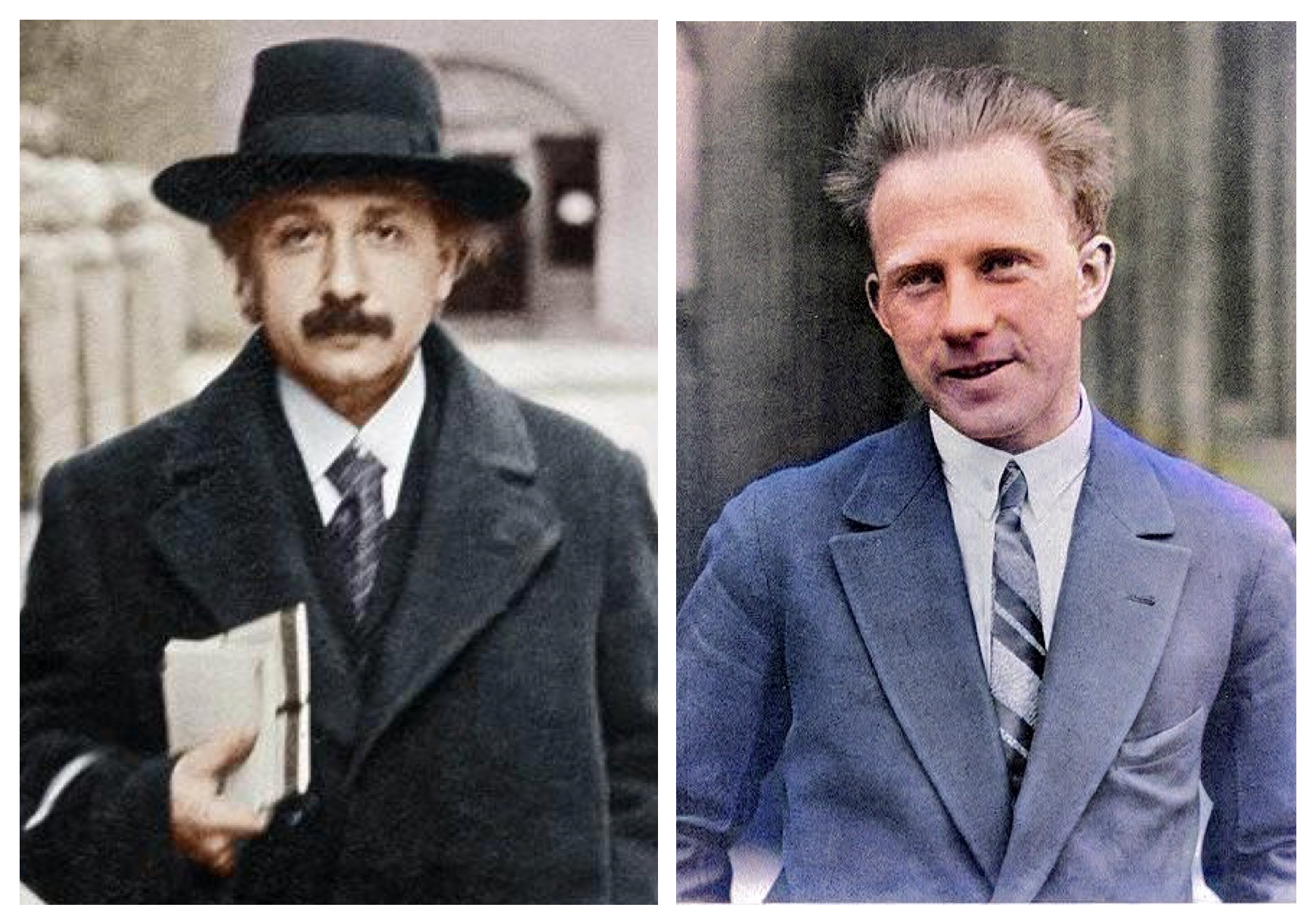
Werner Heisenberg stands as a central figure in the development of modern physics, chiefly recognized for his pioneering work in quantum mechanics. The theories he proposed irrevocably altered scientific understanding of the atomic and subatomic realms, providing a conceptual framework that remains fundamental in contemporary physics. Delving into Heisenberg’s principal theories reveals not only their profound scientific significance, but also their lasting philosophical impact.
The Uncertainty Principle
Perhaps the most celebrated of Heisenberg’s contributions is the Uncertainty Principle, formulated in 1927. This principle asserts that there exists a fundamental limit to the precision with which certain pairs of physical properties, known as conjugate variables, can be simultaneously known. The best-known pair is position and momentum. Mathematically, the uncertainty principle is expressed as:
Δx · Δp ≥ ħ / 2
Here, Δx signifies the positional uncertainty, Δp the momentum uncertainty, and ħ (h-bar) denotes the reduced Planck constant. Heisenberg’s discovery challenged the long-held belief—stemming from classical physics—that, with sufficiently sophisticated measuring instruments, every characteristic of a particle could be determined concurrently with absolute precision.
Consider an experimental scenario involving an electron observed through a photon microscope. Increasing the photon’s energy for a sharper image inevitably disturbs the electron’s momentum due to photon-particle interaction, thus amplifying uncertainty in its momentum. Conversely, using lower-energy photons spares the momentum but yields a less precise location measurement. Heisenberg’s principle, therefore, does not merely reflect a limitation of technology, but rather an intrinsic property of quantum systems—the fabric of reality itself enforces this uncertainty.
Beyond its technical consequences, the Uncertainty Principle invites philosophical reflection. It challenges the deterministic worldview upheld by classical mechanics. Heisenberg himself emphasized that the observer and the observed system are inextricably linked; the act of measurement is an active intervention in quantum phenomena.
Matrix Mechanics: The Initial Quantum Theory
In 1925, at just twenty-three, Heisenberg introduced Matrix Mechanics, representing the first complete and consistent formulation of quantum mechanics. Prior to this, quantum theory was a patchwork of rules proposed by various physicists to address individual phenomena, such as blackbody radiation and atomic spectra. Heisenberg’s approach reimagined the description of quantum phenomena in radical terms.
Instead of modeling electrons as particles moving in precise orbits (as in the Bohr Model), Heisenberg proposed encoding observable quantities—such as the spectral lines emitted by atoms—as mathematical arrays known as matrices. In this framework, physical properties like position and momentum were replaced with matrices whose elements corresponded to transitions between quantum states.
A defining characteristic of matrix mechanics is the non-commutative property of matrix multiplication; for instance, when multiplying two matrices that denote position and momentum, the outcome is contingent on the sequence of their multiplication. This directly establishes the mathematical basis for the uncertainty principle. Max Born, a colleague of Heisenberg, observed that Heisenberg’s “quantum” values adhered to the principles of matrix algebra, thereby facilitating the development of a structured theory.
This theory provided a toolkit for calculating atomic spectral lines with unprecedented accuracy. Heisenberg’s matrices and the concept of quantized observables subsequently became cornerstone ideas within quantum mechanics, later shown to be mathematically equivalent to Erwin Schrödinger’s wave mechanics.
Heisenberg’s Contribution to Quantum Field Theory
As his career progressed, Heisenberg expanded his focus from individual particles to the collective behavior of many-particle systems and fields. In the late 1920s and beyond, he played a pivotal role in the development of Quantum Field Theory, particularly through efforts to understand how interactions, such as electromagnetic and nuclear forces, operate at the quantum level.
Heisenberg suggested that basic interactions ought to be characterized by fields, which are quantized similarly to conventional quantum mechanics. Working alongside Wolfgang Pauli, he played a role in the quantization of the electromagnetic field, a pivotal achievement that forms the basis of quantum electrodynamics (QED). This framework expands quantum theory beyond just particles to encompass the fields with which they engage, thereby establishing the foundation for the Standard Model of particle physics.
The S-Matrix Theory
In the 1940s and 1950s, facing difficulties in characterizing particle collisions and high-energy interactions, Heisenberg focused on creating the S-matrix theory (scattering matrix theory). This methodology aims to connect the starting and ending states of particles during a collision, bypassing the need to detail intricate intermediate interactions.
Heisenberg’s S-matrix theory was especially influential during the formative stages of quantum field theory. It provided an elegant means of extracting observable consequences—such as cross-sections for scattering events—without invoking ill-defined or problematic concepts. Although subsequently superseded by more comprehensive models, the S-matrix approach was foundational to later advancements in both theoretical and experimental particle physics.
Heisenberg’s Non-Linear Spinor Theory
In his quest for a unified field theory, Heisenberg ventured into speculative territory with his Non-Linear Spinor Theory in the 1950s and 1960s. He endeavored to explain the plethora of observed subatomic particles as manifestations of a single fundamental entity governed by non-linear equations. In this vision, protons, neutrons, and other elementary particles would emerge as different solutions to these equations.
Despite the non-linear spinor theory not achieving the experimental triumphs Heisenberg had envisioned, its aspiration for conceptual coherence within particle physics foreshadowed subsequent endeavors, including grand unified theories and string theory. This demonstrated Heisenberg’s persistent determination to explore the boundaries of theoretical physics beyond current understanding.
Philosophical Perspectives and Legacy
Heisenberg’s concepts extended beyond mere technical progress, carrying deep philosophical significance. He posited that the precisely defined principles of classical physics gave way, at the quantum scale, to connections of likelihoods and indeterminacies. His publications, particularly in volumes such as Physics and Philosophy, articulated a scientific perspective where the fundamental nature of reality is not consistently straightforwardly observable, and the inquiries posed influence the responses obtained.
The impact of Heisenberg’s ideas extends far beyond theoretical physics. The uncertainty principle, for instance, is often invoked in fields as diverse as information theory, statistical mechanics, and even popular culture as a metaphor for the limits of knowledge. Matrix mechanics and quantum field theory form the mathematical infrastructure of virtually all modern research in atomic, nuclear, and particle physics.
Heisenberg’s oeuvre reflects the fullest embodiment of scientific creativity: a willingness to depart from the comfort of established doctrine in pursuit of deeper, more accurate accounts of nature’s workings. In shaping quantum mechanics’ conceptual foundations and practical tools, he not only explained the mysteries of the atom but also redefined the boundaries of what can be known and measured. This enduring legacy anchors Heisenberg’s place among the great theorists of the twentieth century.